
Heritage Hills is Oklahoma City’s first historic preservation district — the neighborhood that set the template every other historic OKC district followed. It sits between NW 13th and NW 23rd Streets, bordered by Mesta Park to the west and north and Midtown to the south. Oil businessman Henry Overholser started it in 1903, building his mansion on a hilltop overlooking the new State Capitol and city below, which drew other prominent families — Colcord, Hightower, Hale — to build alongside him. Developer G.A. Nichols later bought up surrounding farmland and built out residential blocks for the city’s elite during the oil-boom years.
How It Got Built
- Development ran from just after 1900 through 1930, combining six original additions — Harndale, West Highland Park, Colcord Heights, Classen’s Highland Park, and two Winans additions — into one neighborhood
- By 1925 the area was fully built out with paved roads, parks, and a new elementary school
- The neighborhood got its current name in 1969, the same year Oklahoma City passed its first historic preservation ordinance — giving residents real zoning authority and the right to approve or reject exterior changes to homes
- Historical Preservation, Inc. formed on September 8, 1969 to enforce those standards; in 1972 it partnered with the American Institute of Architects to acquire and preserve the Overholser Mansion
- Listed on the National Register of Historic Places on July 9, 2010
- Today it’s about 0.24 square miles with roughly 1,189 residents (2020 Census) across 493 households
What You’re Actually Buying Into
This is a walk-through-history streetscape — Châteauesque, Italian Renaissance Revival, Prairie School, Greek Revival, Neoclassical, Craftsman, Tudor Revival, and American Foursquare homes sit side by side, all protected by real historic-district design review. The Hales Mansion (20,021 sq. ft.) is the largest house in Oklahoma City; the Overholser Mansion is the second-largest and open as a museum. Past residents include Jack C. Walton, who served as both the 18th mayor of Oklahoma City and the fifth governor of Oklahoma. Buying here means buying into that design-review process — exterior changes go through the neighborhood’s preservation standards, which is exactly what keeps the streetscape intact.
What Homes Are Actually Selling For
Pulling every recorded sale in Heritage Hills (104 closed transactions, Oklahoma City addresses only), prices have ranged from $135,000 up to $1,800,000, with a median sold price of $735,000 and a median of about $240 per square foot. Inventory here is genuinely small — as of this writing there’s exactly one active listing, at $750,000. That scarcity is normal for a 0.24-square-mile historic district with under 500 households, and it means timing matters more here than in bigger neighborhoods: homes that fit the district’s character don’t sit long.
Looking For a Home Here?
Because Heritage Hills is so small, I track what’s available here personally rather than relying on an automated search — a filtered MLS search can’t isolate this district from the rest of Oklahoma City the way it can for a place like Nichols Hills. Reach out and I’ll send you what’s actually on the market, including anything about to list.
Home Values Over Time
Numbers, not guesses. This is built from 104 closed Heritage Hills sales pulled directly from MLSOK/Matrix — every recorded closing from January 2015 through September 2026 — not a Zillow estimate or a ZIP-code average. Heritage Hills is a tiny, architecturally distinct historic district, so metro-wide or ZIP-level tools miss it badly. This is the real trend line.
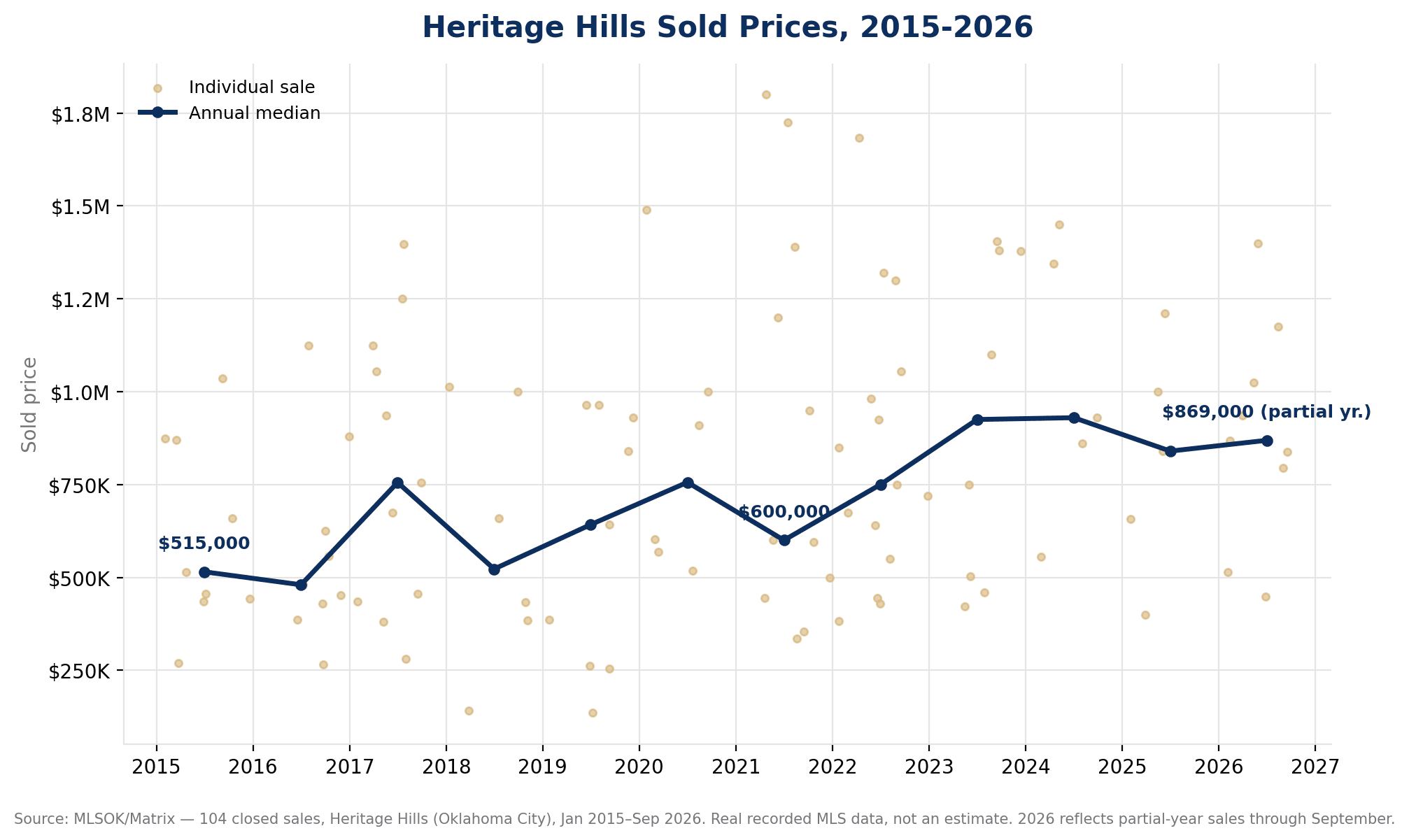
Source: MLSOK/Matrix — 104 closed sales, Heritage Hills (Oklahoma City), Jan 2015–Sep 2026. Real recorded MLS data, not an estimate. 2026 reflects a partial year of sales through September.