Yukon sits just west of Oklahoma City in Canadian County, a town built on flour milling, railroads, and a fierce sense of small-town identity that’s grown into a metro suburb of nearly 28,000 people without losing its Main Street character. Today it’s one of the fastest-growing communities in the OKC metro, and the numbers below tell the real story of what homes here have actually been selling for.
How It Got Built
- The land Yukon sits on was homestead-claimed in the April 22, 1889 Land Run by Minnie Taylor and Luther S. Morrison, who later sold it to Texas cattleman-turned-railroad-builder A.N. Spencer.
- Spencer platted the townsite on February 14, 1891, naming it Yukon — town lore says after Canada’s Yukon Territory, timed to the excitement of the Klondike gold rush era, though the exact reasoning isn’t definitively documented.
- The Choctaw, Oklahoma and Gulf Railway came through in 1891, and the nearby town of Frisco was abandoned as its residents relocated to the new railroad town. Yukon incorporated in 1901.
- The Yukon Mill and Grain Company, founded in 1893, grew into the largest flour plant in Oklahoma and the Southwest by the 1930s, milling 2,000 barrels a day. The mill’s grain elevator, built in 1916, still stands as the town’s tallest landmark — its “Yukon’s Best Flour” sign was restored in 2013 through a community fundraising campaign.
- Czech immigrants began settling here around 1898, and Yukon is officially recognized as the “Czech Capital of Oklahoma.” The Oklahoma Czech Festival has run every October since 1966, hosted at the Yukon Czech Hall.
- Country music star Garth Brooks grew up in Yukon — the town’s main commercial corridor is named Garth Brooks Boulevard, and a 2019 mural on the old mill elevator commemorates his hometown roots alongside the town’s Czech heritage.
What You’re Actually Buying Into
Yukon’s population has more than tripled since 2000, growing from roughly 22,700 residents in 2010 to an estimated 27,615 today — a 16.8% jump since the 2020 census alone. It’s a town that’s absorbed serious growth while keeping its old Route 66 downtown intact; Main Street was bypassed when I-40 went in during the 1960s, and the Yukon 66 Main Street Association has spent years on downtown revitalization. Median household income runs around $75,000, homeownership sits near 69%, and nearly a third of residents hold a bachelor’s degree or higher. It’s a practical commute to Oklahoma City and Tinker AFB, with the small-town feel of a Main Street that still hosts a Czech festival every fall.
What Homes Are Actually Selling For
Between January 2015 and September 2026, 23,588 homes closed in Yukon according to MLSOK/Matrix records. The median closing price has climbed from $167,850 in 2015 to $280,000 so far in 2026 — a steady, sustained run rather than a single spike, with the sharpest jump coming between 2020 and 2022 as the broader metro market accelerated. Prices have held essentially flat through 2025 and into 2026, suggesting the market has settled into a new range rather than continuing to climb.
Current Listings in Yukon
Home Values Over Time
This chart tracks the real median closing price for homes sold in Yukon each year, built directly from MLSOK/Matrix closed-sale records — not an estimate or a model.
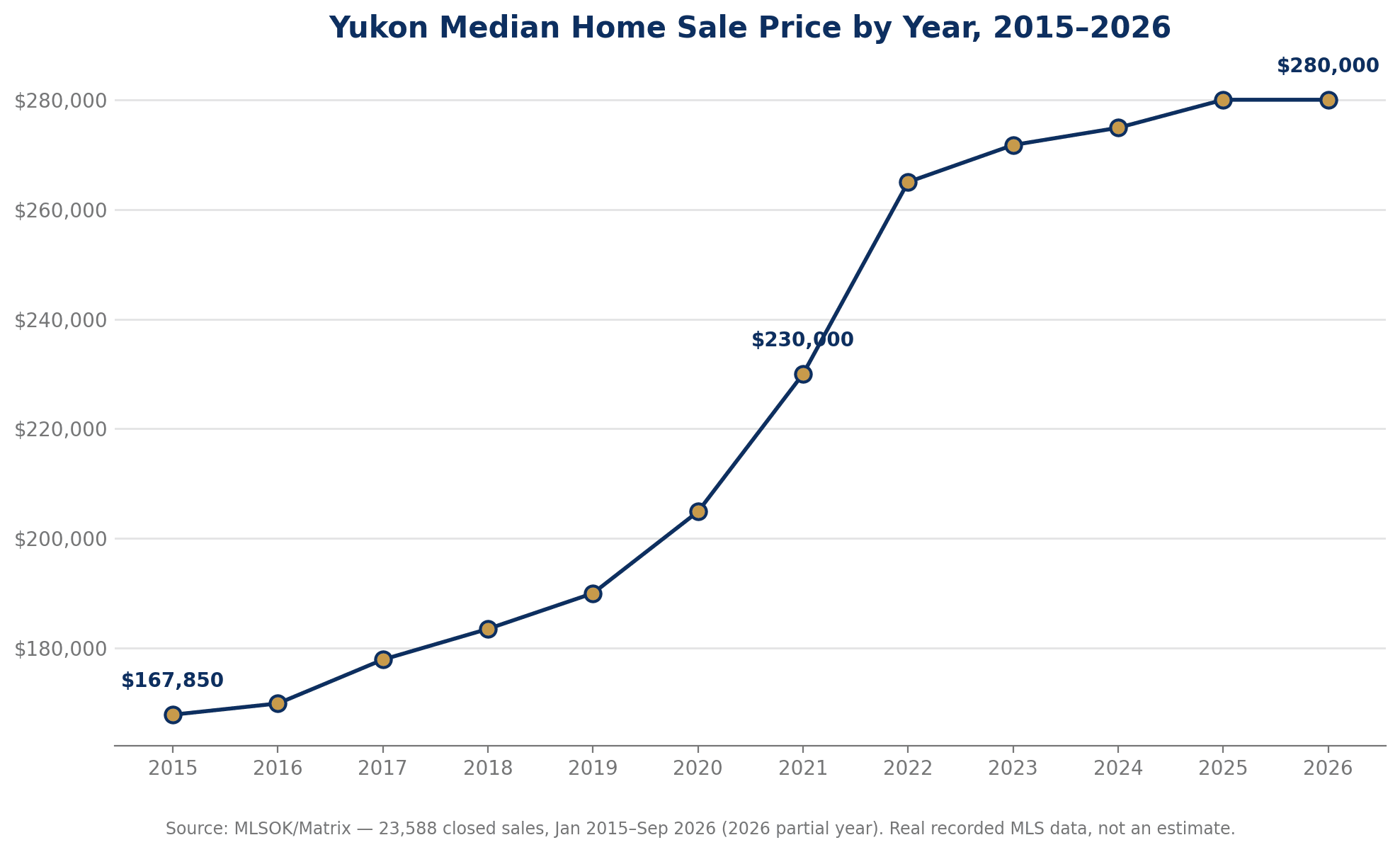
Source: MLSOK/Matrix — 23,588 closed sales, Jan 2015–Sep 2026 (2026 partial year). Real recorded MLS data, not an estimate.