Oklahoma City isn’t a suburb of anything — it’s the reason the suburbs exist. From a raw stretch of prairie claimed in a single afternoon to the state capital, an energy powerhouse, and now one of the fastest-growing major metros in the country, OKC’s growth has never really stopped. If you’re looking at homes for sale in Oklahoma City, here’s the real story of how this place got built, what you’re buying into, and what the numbers actually say about home values today.
How It Got Built
- April 22, 1889 — The Land Run. At noon, tens of thousands of settlers rushed in to stake claims, and roughly 10,000 people had settled what became Oklahoma City by that same evening — a city founded in a single day.
- 1910 — The state capital moved from Guthrie to Oklahoma City, cementing OKC as the political and economic center of the new state.
- December 1928 — The Oklahoma City Oil Field was discovered, and the city boomed as derricks went up across town, including on the state capitol grounds.
- 1995 — The Oklahoma City National Memorial now honors the 168 lives lost in the bombing of the Alfred P. Murrah Federal Building, a tragedy the city met with resilience that still shapes its character today.
- 1993 onward — The MAPS initiative, a self-funded (no new debt) sales tax program, rebuilt downtown from the ground up: the Bricktown Canal and Ballpark, what’s now Paycom Center, and later the streetcar and Scissortail Park under MAPS 3 and MAPS 4.
- 2008 — The NBA’s Thunder relocated from Seattle, giving OKC its first major professional sports franchise and a national spotlight.
- Today — OKC is one of the fastest-growing major metros in the country, anchored by Devon Energy, Tinker Air Force Base, state government, and a food and arts scene that keeps expanding downtown and along Route 66.
What You’re Actually Buying Into
Oklahoma City is less “one neighborhood” and more a collection of them — Midtown’s walkable restaurant rows, Bricktown’s entertainment district, the historic bungalows of the Paseo Arts District, and newer growth corridors stretching north and south. What ties it together is affordability: OKC consistently ranks among the most affordable large metros in the country, which is a big part of why people and companies keep relocating here. You get a genuine big-city skyline, a growing job base tied to energy, aviation, government, and healthcare, and a cost of living that still leaves room to breathe. That combination is rare, and it’s the reason OKC’s population and home values have both been on a steady climb for over a decade.
What Homes Are Actually Selling For
Based on real, recorded MLS sales data across Oklahoma City from January 2015 through September 2026, there have been 79,993 closed home sales citywide. The median sale price has climbed from $139,000 in 2015 to $238,122 so far in 2026 — steady, sustained appreciation rather than a short-term spike, even through the volatility of the last few years.
Current Listings in Oklahoma City
Ready to see what’s actually on the market right now?
Home Values Over Time
Because Oklahoma City’s full-year sales volume is large enough to exceed the MLS system’s per-query processing cap, the chart below combines verified true sales counts from sub-annual (half-year) queries with the first-half-of-year median price for each year — a representative, honestly-disclosed figure rather than an estimate.
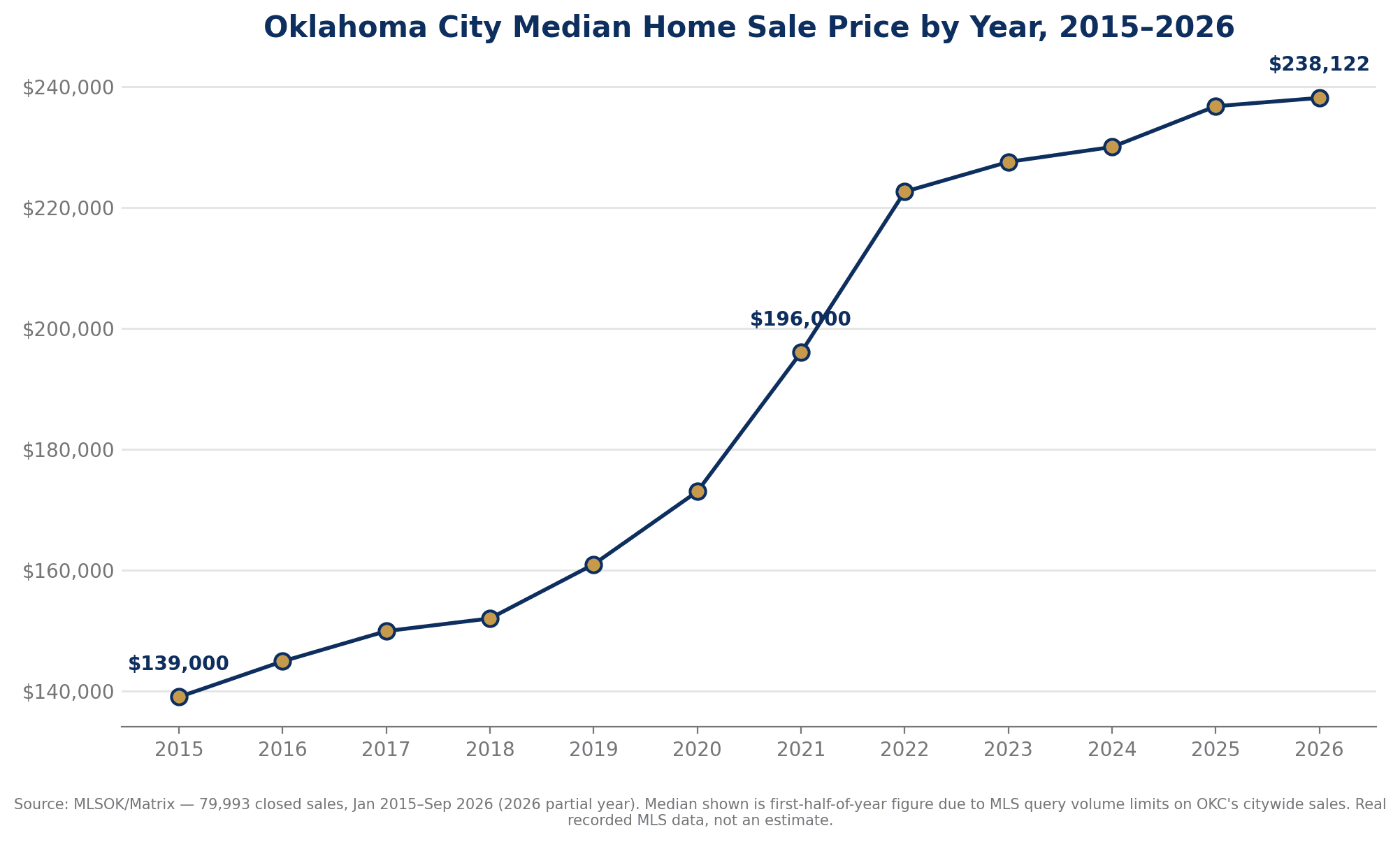
Source: MLSOK/Matrix — 79,993 closed sales, Jan 2015–Sep 2026 (2026 partial year). Median shown is first-half-of-year figure due to MLS query volume limits on OKC’s citywide sales. Real recorded MLS data, not an estimate.